
If you just were in an accident in Miami, you probably expected the responding officer to hand you that familiar “driver exchange” sheet with everybody’s names, insurance details, and vehicle info. Sometimes it happens. Sometimes the officer hands you nothing but a small card with a case number. And sometimes-especially in busy intersections or multi-vehicle collisions-the officer leaves the scene before you get anything at all.
Clients often ask me whether this is legal and whether failing to receive the form can hurt one’s case. The short answer is it will not, and yes, you still can get all the information you need.
Let me walk you through how it works under the law of Florida.
What Florida Law Requires and What It Doesn’t
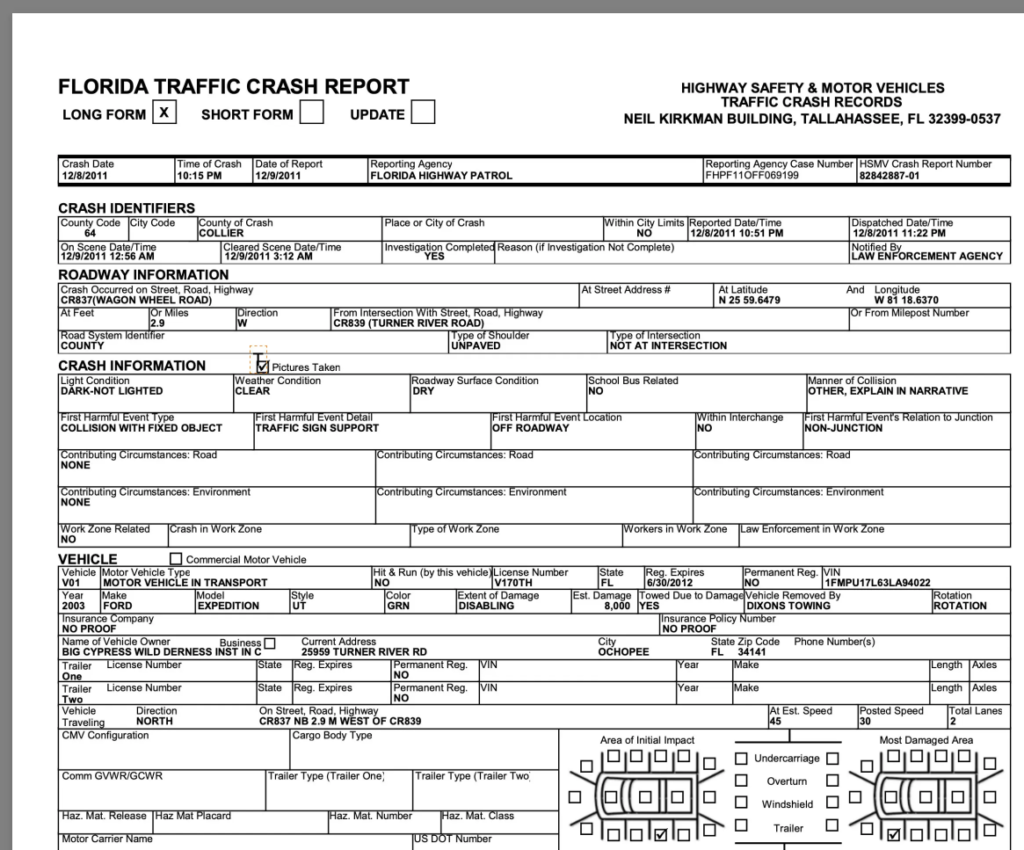
Florida Statute §316.066 gives the rulebook on crash reports. The statute outlines when officers shall investigate and when a written report is required. Whenever there is a crash involving injuries, deaths, hit-and-run, DUI investigation, or at least $500 in property damage, the officer has to complete a long-form crash report. That report includes but is not limited to every driver’s name, their insurance company, vehicle registration, and findings by the officer.
But here’s what the statute doesn’t say: it does not require the officer to physically hand you a “Driver Exchange of Information” form at the scene.
That sheet is just a convenience tool many agencies use to help drivers walk away with the basics. Some departments make it standard procedure, others leave it to the officer. And in the chaos of a crash scene—traffic backing up, injuries to assess, hazards to control—it’s not at all uncommon for the paperwork to be delayed or skipped.
Why Some Officers Give It and Others Don’t
If you have been in more than one crash in Miami, you may notice that completely different approaches are taken by different officers. Here’s why:
These agencies print and pre-fill exchange forms, then train their officers in the use of these forms as part of their routine. Miami-Dade Police and the City of Miami PD use them frequently because it expedites the process of exchanging insurance information and lessens follow-up calls to the station.
Instead, other departments utilize digital reporting systems. They then depend on drivers to get the information when it is available through the crash report.
And then you have the real-life dynamics of the scene: I’ve had clients tell me that the officer was dealing with an irate driver, managing an injured passenger, waiting on a tow truck, or directing heavy traffic. In those moments, handing out forms simply isn’t at the top of the priority list.
How You Can Get the Information Anyway
Even if the officer leaves without giving you anything, you are not out of luck. You still have several easy ways to get all of the information that you need for your insurance claim or personal injury case.
Most crash reports in Florida are posted on the statewide Florida Crash Portal within a few days. Several agencies also maintain their portals online. If you prefer to handle it in person or by phone, records departments at Miami-Dade PD, City of Miami PD, Hialeah PD, and Florida Highway Patrol can provide it directly.
If you are my client, we take this off your plate. We get the complete crash report, find the insurance information for all vehicles involved, and contact the carriers ourselves. No need to chase anyone down, no need to guess whether you have the right information or not.
Not Receiving the Form Does Not Hurt Your Case
A lot of people are concerned that not getting a driver exchange form somehow weakens their claim or delays medical treatment. It doesn’t.
Insurance companies do not require the physical sheet. They require the policy number and carrier, which is information that appears in the crash report. And even if the insurance information happens to be missing or incorrect, we can track it through state databases, vehicle tags, and direct contact with the agency that handled the crash.
Your personal injury case is not based on what the officer handed you at the scene, it’s based on liability, medical treatment, documentation, and timely legal action.
What This Looks Like in Real Life
Here is what I foresee happening about once a week: someone gets rear-ended on the Palmetto, police take statements, give them a case number card, and inform them the report will be ready in a few days. The injured driver goes home confused and thinks they cannot start their claim until they get the sheet.
But the insurance company doesn’t wait for the form. They wait for us to call.
By the time the report gets uploaded, we have contacted the carrier, opened a claim, set up property damage repairs, and coordinated medical care. The driver exchange form may make things seem more tidy, but it really doesn’t drive what happens next.
The Bottom Line
Florida police officers are not required by law to provide a driver exchange of information form after an accident. Some do, some don’t, and more often than not it depends on what happened at the scene. What counts is that official crash report will have the information you need-and if you have an attorney you don’t have to go through the hassle of tracking it down.
If you were in an accident and you left the scene with nothing but a case number-or nothing at all-you are not alone. And you are not at a disadvantage either.
Call Mr. 786 Abogado, Jaime Suarez, and let us help you get your Florida crash report, secure the insurance information, preserve the evidence, and protect your injury claim from day one.