

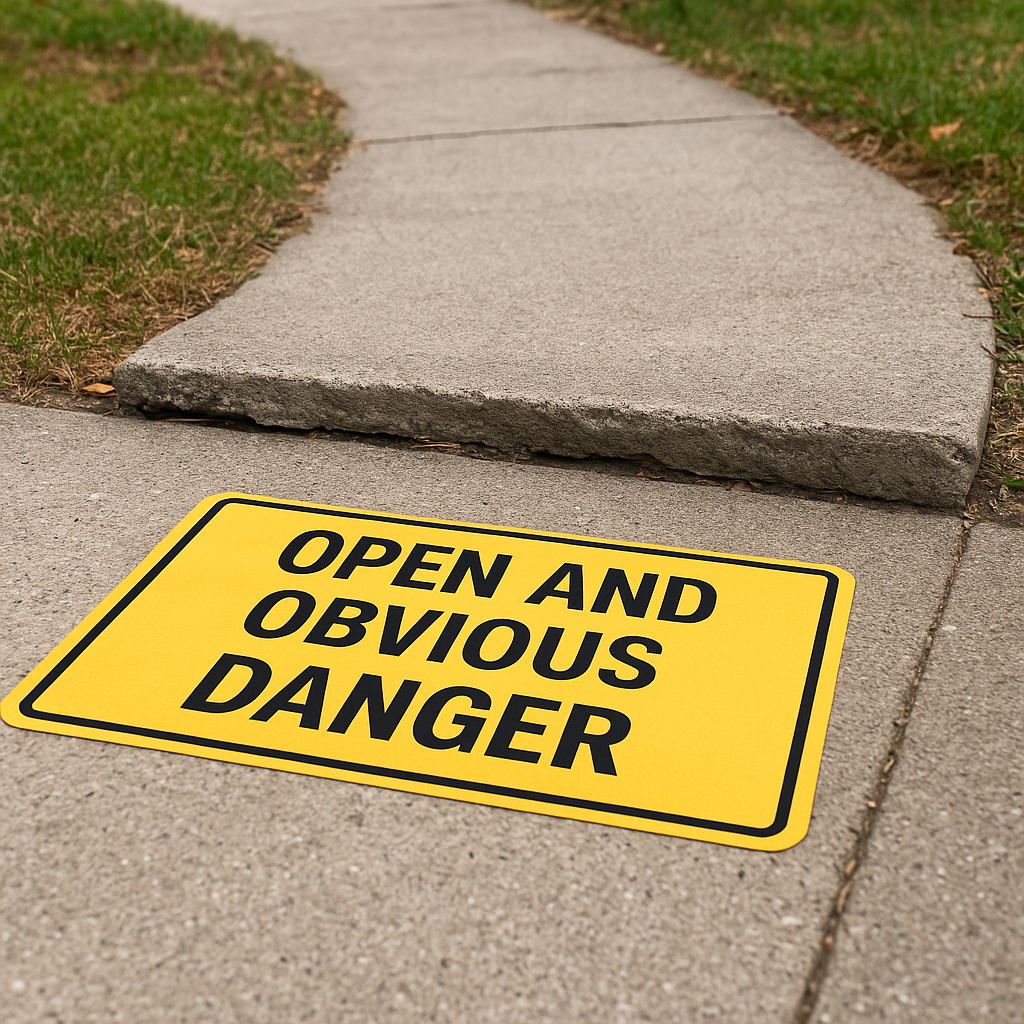
Have you ever injured yourself on somebody else’s property — maybe at a grocery store, in an apartment complex, or entering a store? You’ve probably wondered: Geez maybe I could have avoided that specific danger? Do I have a case? One of the toughest issues we deal with as Florida injury attorneys is something called the “open and obvious” doctrine.
At Suarez & Montero, we’ve represented countless clients in Miami, Broward, and across South Florida who were hurt in situations where property owners claimed the danger was “obvious.” Insurance companies love to use this defense because it can reduce or even eliminate their responsibility. But the truth is, these cases are rarely as cut and dry as the other side makes them sound.
Let us dissect this in laymen’s terms, so you understand how this doctrine works and how it impacts your case.
What Is Florida’s Open and Obvious Doctrine?
According to Florida law, it is up to an owner to make sure his premises are not hazardous to those invited onto the property (think of customers at a store, tenants of an apartment complex, or even guests to a company party). But it is not an open-ended one.
The open and obvious rule is that where a condition on the property is so apparent and noticeable that any reasonable person would notice it and avoid it, the property owner does not necessarily have to warn their guests of it.
For example:
- A large, bright yellow construction barricade in the path of a hallway.
- A large puddle in plain sight on a sunny day.
- A set of stairs without a railing where the danger is clear at first glance.
In these situations, the argument is that you should have seen the danger and taken some action to avoid it.
Why Property Owners Love This Defense
When you file a premises liability case — for a slip and fall, trip and fall, or some other kind of injury — the property owner (and insurance company) will usually try to avoid paying anything. The open and obvious doctrine is one of their favorite tools.
They’ll argue:
- “Anyone could have seen that crack in the sidewalk.”
- “When the risk was right before their eyes — they just weren’t paying attention.”
- “We didn’t have to put up a warning sign because it was obvious.”
It’s sounding plausible enough at first, and many people who are hurt become discouraged when they’ve heard this reasoning. Don’t let this discourage you from consulting with an attorney. Florida law is more complex than property owners would lead you to believe.
The Key Question: Did the Owner Still Have a Duty?
Something insurance companies aren’t going to tell you: even when there’s an open and obvious condition, Florida courts have ruled that owners are responsible if they could reasonably assume that individuals would nevertheless get hurt even though the risk existed.
That is to say:
- If the condition was in a high-traffic location where individuals had no means to avoid encountering it.
- If distractions rendered it likely visitors wouldn’t notice the hazard.
- If the risk posed was dangerous enough that merely posting a warning for it would be inadequate.
- Illustration: imagine a shopping mall with a huge cracked curb at one parking lot entrance. Even if the danger is visible, the owner of the property can anticipate that people will still have to drive or walk over it. In that case, they can’t simply shrug and say, “Well, you should have seen it.”
Comparative Negligence and How It Plays In
Florida uses “modified” comparative negligence, so even if you were partially at fault for your accident (maybe you weren’t driving it your whole attention, or you walked into a risk you could have avoided), you can still receive payment — it will just be reduced by your portion of fault.
Suppose, for instance, a jury finds:
- You were 20% at fault because the risk was obvious.
- The property owner was 80% at fault for failing to fix it.
If your loss was $100,000, you may still be able to recover $80,000.
This is an enormous reason not to give up because the defense argues that the risk was open and obvious. Several of our clients have recovered large sums of money even after open and obvious doctrine has been plead.
Real-World Examples We See
To be more specific, the following are a few of the circumstances in which the open and obvious doctrine often appears in South Florida personal injury cases:
- Uneven sidewalks – Miami and Fort Lauderdale are full of cracked and broken sidewalks that have depressions and raised slabs. Owners say these are obvious, but courts generally hold that they are still dangerous, especially at night or in distracted locations and especially if the owner had prior notice of its existence and chooses to ignore it.
- Parking lot hazards – Wheel stops, potholes, or curb are common fall causes. Owners say “you should have seen it,” but when lots aren’t well lighted or conditions force you to need to walk through those areas, there is still liability.
- Aisle displays – Warehouse clubs like Walmart or Home Depot prefer to pile up items in aisles. They acknowledge that the risk is evident, but how items are placed can create subtle hazards for trips.
- Staircases and handrails – Missing or damaged handrails are “apparent,” but until a landlord gets them repaired, they will be held responsible when someone does fall.
- Slick floors – Restaurant or supermarket spills often blend into tile floors. What subsequently seems “obvious” may well have gone unnoticed initially.
Why These Cases Need Experienced Legal Representation
One of the more challenging aspects of an obvious and open case is establishing that the owner still had a responsibility to act. Insurance companies will fight to avoid liability, distorting facts to make you appear as if you weren’t paying attention.
We know how to refute those claims at Suarez & Montero. That includes:
- Examining lighting, visibility, and distractions at the scene of the accident.
- Gathering witness testimony and security footage.
- Summoning experts if necessary to prove the hazard wasn’t as self-evident as claimed.
- Highlighting occasions where the owner should have reasonably anticipated harm regardless.
- We’ve seen firsthand how these facts can turn a “hopeless” case into a strong one.
What This Means for Our Clients
If you’re a Suarez & Montero client — or considering contacting us — here’s what you need to know:
- Don’t assume you have no case. Simply because someone testifies the risk was obvious doesn’t make it a fact in law.
- Your vigilance is valuable, but it’s only part of it. Florida does allow partial fault, and that does not eliminate your right to receive compensation.
- Every detail counts. Where the risk was located, how it looked, what kind of lighting existed — these factors can win or lose your case.
You require a warrior in your corner. Owners possess attorneys and insurance adjusters who are well-versed in this doctrine. You should have a staff that knows how to out-fight them at their game.
Final Thoughts
Florida’s open and obvious doctrine is convoluted — but don’t assume you’re out of luck if you’ve been hurt. Property owners can’t simply employ the “you should have seen it” cop-out as a defense, especially if they’re aware of the danger and choose to ignore it. If they didn’t maintain the premises in a safe manner or placed out a danger that you walked into harm, they can and should be held liable.
At Suarez & Montero, we have helped injured victims all around Florida through cases such as these. We treat you like family, and we will not allow those insurance giants to strong-arm you.
If you or a family member has been injured, call Jaim “Mr. 786 Abogado” Suarez today to Get You Paid!